Sunday, May 1, 2016

The Duality of Human Nature

“I learned to recognize the thorough and primitive duality of man; I saw that, of the two natures that contended in the field of my consciousness, even if I could rightly be said to be either, it was only because I was radically both.” -Robert Stevenson in The Strange Case of Dr. Jekyll and Mr. Hyde

The duality of human nature can be separated in several different categories including good and evil, male and female, and right and left hemispheres. For the sake of this blog post, I'd like to consider the duality of human nature as being between good and evil.

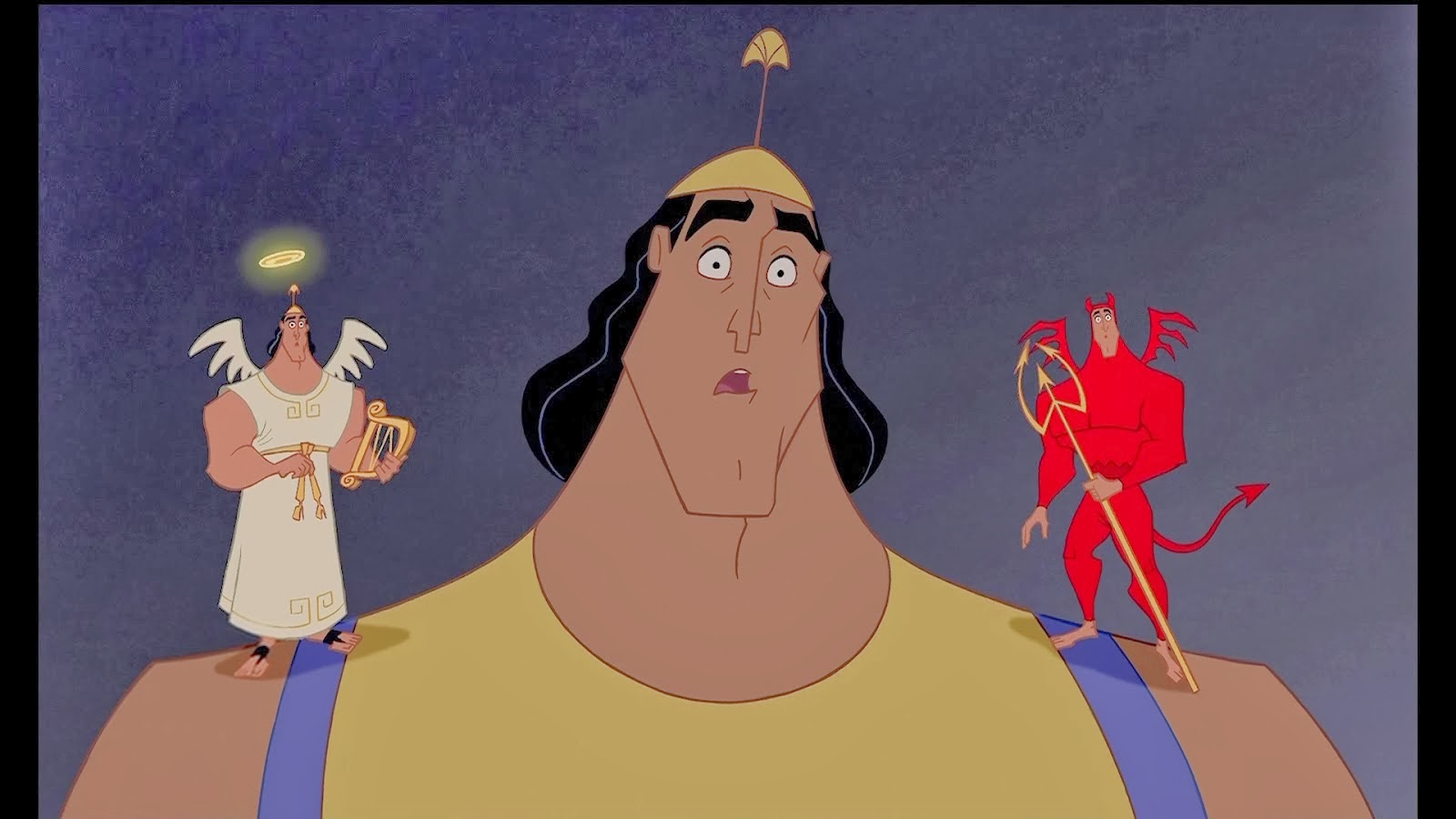
As I ponder the topic of the duality of human nature I automatically imagine the scenes in The Emperor's New Groove where Kronk has a white angel on his right shoulder and a red devil on his left shoulder arguing over decisions Kronk must make. This image takes the duality of human nature and makes it outwardly visible and easy to understand.

A piece of literature that undeniably illustrates the duality of human nature is The Strange Case of Dr. Jekyll and Mr. Hyde by Robert Louis Stevenson. In Chapter 10, Jekyll writes clearly about the dual nature of human beings. He says that, as a young, educated man from a respectable family, he maintained an appearance of good behavior at all times. But he says this was a fraud - no one suspected his true nature, which was at times extremely immoral. Jekyll's experiments began in an attempt to separate the two sides of human nature and destroy the evil one. He discovered that the evil part of his nature was, indeed, part of himself, and therefore, in some sense, natural and part of the whole.

We, as human beings, all have both good and evil inside of us. According to The Strange Case of Dr. Jekyll and Mr. Hyde, it is natural for there to be conflict between the forces of good and evil within us. The novel also argues that the duality of human nature is unable to be separated. I agree that the duality of human nature is natural, however, I'd like to believe that we are able to separate it.

Thursday, March 31, 2016

The Corrupting Nature of the Human Desire for Power

     The corrupting nature of the desire for power is a popular theme within many well-know pieces of literature. Look at Julius Caesar, Animal Farm, Lord of The Flies, and Great Gatsby. All of the main characters from those pieces of literature faced corruption due to their unquenchable desire for power.
      Another piece of literature that brings attention to this theme is Dr. Faustus by Christopher Marlowe. A big motivator for Faustus's handing his soul over to the devil is his desire for power. But here's the problem: in order to gain that power, Faustus has to give it all away—to Lucifer. Ultimately, the power Faustus dreams of could never be his. The power to rule not just men but all of creation belongs only to God in the world of Doctor Faustus. But the not-so-good doctor is not the only one in the play who has such high ambitions. Pope Adrian, too, uses his power to make all the world "stoop." We also know that Lucifer fell from heaven because of his lust for power. So the Pope and Faustus are probably destined to wind up right where Lucifer is—in hell.
      The corrupting nature of the human desire for power is obvious present in literature but is it an issue in "the real world"? Absolutely! One word: POLITICIANS. Corruption is characterized as the abuse of public resources, power and position to provide unfair advantage to individuals, families and friends. Common public resources that are often pocketed by politicians are money, goods, medical aid funds and budget allocations. Crazy, right? Take a look at Budd Dwyer:
                                                  
Dwyer was a Republican politician from Pennsylvania, Budd Dwyer was a member of the state House of Representatives from 1965 to 1970, and spent the following decade in the state Senate. Dwyer was then elected state Treasurer -- the post he held until committing suicide.

On January 22, 1987, Dwyer was one day away from a federal court sentencing hearing after a jury found him guilty of taking $300,000 in campaign donations from a computer company in a quid pro quo exchange for a $4 million state contract. Dwyer was also accused of five counts of mail fraud, four counts of inter-state transportation in aiding racketeering and one count of conspiracy to commit bribery. Dwyer faced a maximum of 55 years in prison and a $300,000 fine.

At a press conference the morning of January 22, with TV cameras rolling and reporters watching, Dwyer pulled out a loaded .357 Magnum from a manila envelope and took his own life

Dwyer had power, he was in the House of Representatives, the Senate, and then PA's state treasurer, but he wanted MORE. Not only is the desire for power corrupting, it's also unquenchable and eventually lethal.

Monday, February 29, 2016

Gender Roles: That was Then, This is Now?

       Gender roles are a hot topic in modern American society, as well as around the world. Should women be destined to be stay at home moms who wait on their husband's every need? Should men be forced to be the only breadwinner of the family and be looked down upon for being kind and compassionate to their children and wife? The short answer is no. First, let's take a look at gender roles in 1900s. One essay that outlines the gender roles during this time period, specifically those of women, is "A Room of One's Own", by Virginia Woolf. The presentation of women in "A Room of One's Own" is focused on the reasons and conditions that make it difficult for women to be artists or novelists. First of all, women could not be great artists or novelists because there was no freedom for them. They experienced great material constraints. Women were dependent financially on men. The effect of the role provided for women like this is that they became subservient to men. Here women only became the property of men: "...the poison and bitterness in those days bred in me...To begin with, always to be doing work that one did not wish to do, and to do it like a slave, flattering and fawning, not always necessarily perhaps, but it seemed necessary and the stakes were too great to run risks".  In this quotation taken from "A Room of One's Own", it is clear that women generally had to do jobs they did not like, and what makes things worse was they had to do it with subservient attitudes like slaves. Some occupations that were open to women before 1918, Woolf noted, were “addressing envelopes, reading to old ladies, making artificial flowers, teaching the alphabet to small children in a kindergarten.” These economical and social constraints surely bred poison and bitterness in women who might have more capacity than doing menial works and also hampered them in actualizing themselves.
Back in the 18th and 19th centuries (and essentially all of history), women had little to no choice when it came to their future role as a housewife and servant to their husband. Has anything changed? To a degree. Of course women can vote, be land owners, and make their own money, but are they still pressured to be a certain way and fulfill a certain role? I would say yes. As I was doing research for the upcoming "Cult of Domesticity" discussion, I came across an ad that was filmed during the current 2016 year, in India, promoting a laundry detergent. Why laundry detergent? I'll get to that. This ad is titled, "An Apology From A Dad To His Daughter, On Behalf Of Fathers Everywhere." The ad features a father overseeing the relationship between his daughter and her husband. The daughter is taking a conference call while taking care of the children, cooking dinner, cleaning, and washing clothes. The husband is sitting on the couch watching tv and ordering his wife to wash his shirt. The father apologizes for never stopping his daughter as she played house and played manager of the house when she was younger and for not helping his own wife with work around the house. He also apologizes on behalf of her husband as he has learned his behavior from his father. The father sees the issue and addresses it by promising to help his wife with the laundry and do things around the house, thus the laundry detergent and the ad's slogan of #ShareTheLoad. America, like the father in this ad, has seen the issue between gender roles, now it just needs to be addressed. 

Here is the link for the ad if you care to watch it: http://youtu.be/vwW0X9f0mME

Sunday, January 31, 2016

Women and Sexism.


        "What’s the sense in schooling a girl like you? It’s like shining a spittoon. There is only one skill a woman like you and me needs in life... tahamul. Endure.”  Mariam later understands her mother's brutally honest words and what it means to "tahamul" as she is constantly belittled, persecuted, and declared illegitimate due to her gender. Khaled Hosseini in his novel, A Thousand Splendid Suns, accurately portrays many of the inequities women in Afghanistan faced during the 1960s- early 2000s. Women were not considered equal to men, they were expected to comply to whatever men wanted. They were sub-par. A few examples I discovered include Mariam's forced arranged marriage, Rasheen's requirement for Mariam and Laila to wear a burqa because "a woman's face is only for her husband" yet Rasheen has a magazine of barely clothed women in his dresser, Laila and Mariam being forced to be housewives and being unable to financially support themselves, the spousal abuse that Laila and Mariam endure, Laila and Mariam not being able to ride the bus because they didn't have a man with them, the fact that the only hospital where women are allowed (when Laila needed help delivering Zalmai), was completely ill-equipped, and the contrast between Rasheen's disgust for "his" daughter and his pride in his son. Sexism, especially towards women, is prevalent throughout the entire novel. 
       While it's not even close to being comparable to the extreme sexism that existed and still exists in Afghanistan, there is also sexism within the United States. I have yet to meet a woman who hasn't been bothered in the street, one of the key examples of casual sexism. How many times have you been walking along, minding your own business, before being shouted at a man in a passing car, or bothered by some builders on the side of the road? It can be anything from a horn being tooted at you, to shouting things that are distinctly more unsavory. How about school aged girls being sent to the office because their clothing is too "distracting for the boys." I completely understand the necessity for a dress code, but telling girls that the reason for the dress code is so that you aren't distracting the opposite gender from learning, is insane. If a boy is too distracted to do his work because he can see my shoulder, he's got bigger problems. This is sexism. I'm not saying men don't face legitimate sexism, they do. For example, if a man and a woman comit the same crime, it is proven that the man will most often recieve a harsher punishment. Also, if the man and woman committed the crime together, the man is often charged as the "initiator." Another example is in divorce cases, the courts mainly side with the mother in custody battles over children. Male sexism is real as well, it's just not as prevalent or as advertised as sexism against females.
       Yes, women in America can now vote, work outside of the home, own property, and do many things that women in other countries cannot do but it doesn't mean sexism is gone in America. It's definitely still here and women should continue to fight for equal rights.
"A woman is human. She is not better, wiser, stronger, more intelligent, more creative, or more responsible than a man. Likewise, she is never less. Equality is given. A woman is human." - Vera Nazarian.